
376 Inspections Done
What is the California Balcony Inspection Legislative Guide?
Add a header to begin generating the table of contents
What is the California Balcony Inspection Legislative Guide?
The California Balcony Inspection Legislative Guide centralizes 2025 and 2026 California exterior elevated element laws. The guide identifies which statute applies, which deadline controls, which inspector qualifies, and which disclosure duties affect compliance and resale.
California balcony law operates as a two-track legal system. Health and Safety Code §17973 governs qualifying apartment properties. Civil Code §5551 governs qualifying condominium associations. SB 410 adds HOA resale disclosure consequences effective January 1, 2026. AB 2579 extended the apartment deadline. AB 2114 expanded the HOA inspector pool.
The California Balcony Inspection Legislative Guide functions as a sub-seed page inside the /eee-safety-compliance/ cluster. The page defines legal boundaries for the topic. The page routes users to SB 721, SB 326, AB 2579, AB 2114, SB 410, and local-law comparison nodes.
Visual Plan: Legislative Hierarchy Flowchart
Alt text: Flowchart showing California balcony inspection law hierarchy. The chart maps SB 721, SB 326, AB 2579, AB 2114, and SB 410.
Which specific California laws mandate periodic balcony inspections?
California mandates periodic balcony inspections through SB 721 and SB 326 under 2025 and 2026 compliance rules. Senate Bill 721 is codified in Health and Safety Code §17973. Senate Bill 326 is codified in Civil Code §5551. SB 721 governs qualifying multifamily rental buildings. SB 326 governs qualifying condominium projects where associations hold maintenance or repair responsibility.
California uses separate statutes because ownership structure changes legal responsibility. Apartment owners control inspection and repair directly. Associations control inspection and repair through governance records, reserve studies, and board administration. Statutory distinctions explain why California uses different cycles, sampling rules, disclosure duties, and inspector pools.
Visual Plan: SB 721 vs SB 326 Comparison Table
Alt text: Comparison table showing SB 721 and SB 326 differences. The table compares property type, deadline, cycle, inspector pool, sampling method, and consequences.
What is the role of Senate Bill 721 in the legal hierarchy?
Senate Bill 721 governs qualifying apartment buildings and sets the January 1, 2026 initial inspection deadline. Health and Safety Code §17973 requires recurring inspection every six years. Senate Bill 721 also controls report timing, permit timing, repair escalation, urgent-condition notice, and civil-penalty exposure.
Senate Bill 721 sits in this sub-seed as the apartment-law branch. The dedicated child node handles the 15 percent sampling rule. The node explains the 45-day reporting deadline. The node explains the 15-day urgent-condition notice. The node maps the 120-day permit rule and the penalty sequence.
What is the purpose of Senate Bill 326 in the legal hierarchy?
Senate Bill 326 governs qualifying condominium associations and sets the January 1, 2025 initial inspection deadline. Civil Code §5551 requires recurring inspection every nine years. Senate Bill 326 also requires a random and statistically significant sample. The statute also integrates the inspection report into the reserve study process.
Senate Bill 326 sits in this sub-seed as the HOA and condo-law branch. The dedicated child node handles the 95 percent confidence standard. The node explains the random-list requirement. The node explains association record retention. The node explains reserve-study integration.
How does Assembly Bill 2579 affect the current compliance timeline?
Assembly Bill 2579 extends the SB 721 apartment deadline to January 1, 2026 and leaves SB 326 unchanged. Civil Code §5551 keeps the HOA deadline at January 1, 2025. As of March 2026, both initial deadlines are in the past. The statutes reached that point through different legislative paths.
Assembly Bill 2579 matters because stale pages still cite January 1, 2025 for apartment properties. AB 2579 amended Section 17973 and moved the initial apartment deadline forward by one year. Civil Code §5551 did not receive the same extension.
Why is the SB 721 deadline page still important after January 1, 2026?
The SB 721 deadline page remains important after January 1, 2026 because AB 2579 defines the controlling apartment deadline. The page explains why the deadline changed. The page shows which date now controls the statute. The page also maps post-deadline enforcement exposure under Health and Safety Code §17973.
Assembly Bill 2579 now functions as legal-history content and compliance-status content. The child node explains what the bill changed. The node explains why the change occurred. The node explains how the amendment affects current apartment-law interpretation.
Why did the SB 326 deadline remain January 1, 2025?
Civil Code §5551 keeps the first HOA inspection deadline at January 1, 2025 for qualifying associations. Qualifying associations entered the post-deadline compliance phase before apartment properties. AB 2114 identifies additional authorized inspectors under Civil Code §5551. AB 2114 does not change the deadline itself.
Civil Code §5551 anchors HOA timing, inspection method, reserve-study integration, and record retention. The SB 326 child node focuses on those duties. The node does not repeat apartment-law timing rules.
What are the new SB 410 real estate disclosure mandates for 2026?
SB 410 requires the most recent Section 5551 report in resale disclosures effective January 1, 2026. SB 410 also treats those reports as association records. The law also adds required first-page report content for HOA resale review.
SB 410 changes the legal significance of the HOA inspection report. Before SB 410, the report mainly served maintenance and reserve-planning functions. After SB 410, the same report also serves as a resale-disclosure document during transaction review.
What first-page summary items now define an SB 410-compliant report?
SB 410 requires first-page summary items that standardize 2026 HOA inspection disclosures under Civil Code §5551. The first page lists the inspection date, project-unit totals, exterior elevated element totals, inspected element totals, immediate-threat totals, affected-unit totals, and sample-certification language.
SB 410 converts those first-page items into standardized legal disclosures. The dedicated SB 410 child node explains each required line item. The node shows how the first page affects association records, buyer review, and resale due diligence.
How does SB 410 affect escrow and mortgage review?
SB 410 increases escrow and mortgage scrutiny because Section 5551 reports now move with resale disclosure packages. Buyers, agents, lenders, and escrow teams can review inspection status more easily during a transaction. That transparency increases attention on missing reports and unresolved exterior elevated element conditions.
SB 410 does not use the word blacklisting in the statute. The accurate takeaway is narrower. A disclosed inspection gap creates more transaction friction. An unresolved EEE condition also creates more friction. The report is now a required disclosure document.
Who is authorized to certify structural safety under California law?
California law authorizes a broader inspector pool for SB 721 and a narrower pool for SB 326. Health and Safety Code §17973 allows architects, engineers, certain certified inspectors, and certain licensed contractors. Civil Code §5551 limits the HOA pool to licensed architects and engineers, including civil engineers after AB 2114.
Inspector qualification controls legal validity, not only procurement preference. A professional who qualifies under the apartment statute does not automatically qualify under the HOA statute. The sub-seed page states that distinction clearly and routes users to the correct child page.
Which professionals can perform SB 721 apartment inspections?
Health and Safety Code §17973 authorizes architects, engineers, certified inspectors, officials, and certain contractors for SB 721 inspections. Eligible contractors include A, B, or C-5 classifications. Eligible contractors also need at least five years of multistory wood-frame experience.
The SB 721 child node explains how those qualifications interact with report authorship. The node explains local-jurisdiction independence. The node also explains the statute’s safety and waterproofing inspection scope.
Why does SB 326 use a narrower inspector pool?
Civil Code §5551 restricts HOA inspections to licensed architects, civil engineers, and structural engineers. The statute ties the inspection to statistical sampling, reserve-study integration, and association-record duties. AB 2114 broadened the pool by adding licensed civil engineers. The HOA pool still remains narrower than SB 721’s pool.
The SB 326 child node explains AB 2114 as the civil-engineer expansion bill. The node distinguishes that amendment from the deadline change in AB 2579. The node also distinguishes it from the disclosure changes in SB 410.
What legal and financial consequences define post-deadline non-compliance?
Post-deadline non-compliance creates civil penalties, repair pressure, disclosure exposure, and transaction consequences under 2025 and 2026 law. Health and Safety Code §17973 authorizes daily civil penalties for apartments. Civil Code §5551 and SB 410 increase reserve-planning pressure and disclosure visibility for associations.
California law does not treat missed EEE compliance as a minor paperwork issue. Apartment-law consequences focus on repair escalation, notices, penalties, and possible liens. HOA-law consequences focus on reserve-study integration, disclosure visibility, and association-record accountability.
How do daily civil penalties work under SB 721?
Health and Safety Code §17973 authorizes daily civil penalties of $100 to $500 under SB 721. Penalties apply after the owner misses required repairs and remains out of compliance through the statute’s notice sequence. Penalties continue if the violation remains uncured for 30 days after notice.
The SB 721 child node maps the full sequence in order. The sequence includes inspection, report, repair recommendation, emergency measures, permit application, repair completion, inspector notice, and daily penalties.
How does non-compliance affect HOA reserve studies and resale review?
Civil Code §5551 and SB 410 increase budgeting pressure and resale visibility for non-compliant associations. Civil Code §5551 requires inspection findings in the reserve study process. SB 410 requires the most recent report in resale disclosure documents. Together, those laws increase both budgeting pressure and transaction visibility.
The SB 326 and SB 410 child nodes work together here. One page explains reserve-study integration. The other page explains disclosure-package consequences, first-page report requirements, and the resulting effect on resale diligence.
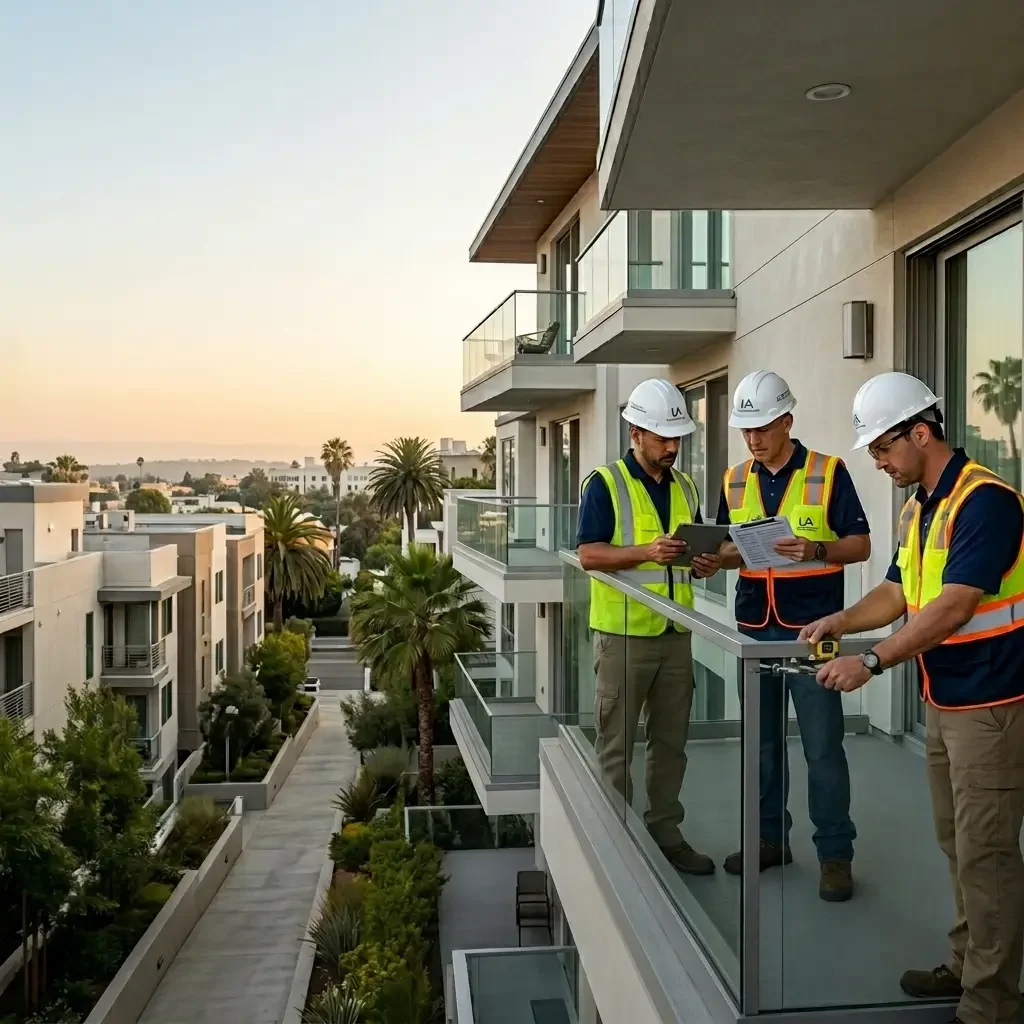
About us
Why Los Angeles
Trusts Our Team.
Local Expertise
Deep understanding of Los Angeles building codes and LAHD reporting requirements.
Fast Turnaround
We deliver comprehensive, signed reports within 45 days of inspection completion.
Transparent Pricing
No hidden fees. We provide clear, upfront quotes based on your specific property needs.
376+ Projects
Licensed & ISO Certified
Experienced Team
Not sure whether the building falls under SB 721 or SB 326?
Los Angeles properties often need a law-and-scope review before inspection scheduling. Building type, ownership structure, balcony configuration, and exterior elevated element count all affect the compliance path, report requirements, and repeat cycle.
Get Free Consultation