
376 Inspections Done
Mastering EEE Safety Compliance in California
Essential guidance for owners, HOA boards, and property managers on SB 721 and SB 326. Ensure safety for balconies, decks, stairs, and walkways.
Get Free Consultation
The “3-2-6” Rule
A quick shorthand to identify regulated California properties. If your structure meets these criteria, compliance is mandatory.
3
Multifamily Units
Buildings containing 3+ dwelling units.
2
Statutes
Split between SB 721 and SB 326.
6
Feet of Elevation
Elements standing 6+ feet above grade.
What Qualifies as an EEE?
California defines Exterior Elevated Elements as structures that extend beyond exterior walls and rely on wood-based structural support.
Balconies
Decks
Porches
Stairways
Walkways
Entry Structures
*Human use is part of the statutory definition. Qualification begins with satisfying height, use, and wood-support tests.
Add a header to begin generating the table of contents
What is California EEE safety compliance for balconies, decks, stairs, and walkways?
California EEE safety compliance requires owners, HOA boards, and property managers to identify the governing statute, confirm whether a structure qualifies as an exterior elevated element, and complete inspection and repair duties within the correct legal timeline. Health and Safety Code §17973 governs qualifying apartment properties. Civil Code §5551 governs qualifying HOA and condominium properties.
California owners do not follow one universal balcony law. California owners follow a property-type compliance path. Apartment ownership, HOA governance, inspector eligibility, sampling rules, and reporting duties operate under different statutes.
Which specific California laws mandate periodic balcony inspections?
California mandates periodic exterior elevated element inspections through Health and Safety Code §17973 for qualifying apartment buildings and Civil Code §5551 for qualifying HOA-governed condominium properties. Review mandatory California balcony laws to compare the governing statutes, deadlines, and ownership-based compliance paths.
California law separates these statutes by ownership model. Concealed decay, water intrusion, and structural failure create the safety risk addressed by both laws.
Health and Safety Code §17973 applies to qualifying multifamily apartment properties. Civil Code §5551 applies to qualifying common interest developments with association maintenance responsibility. Statutory alignment determines the correct compliance path.
What is the role of Senate Bill 721 in California EEE safety compliance?
Senate Bill 721 governs exterior elevated element inspections for qualifying multifamily apartment buildings under Health and Safety Code §17973. The first inspection deadline is January 1, 2026. Owners must comply with SB 721 apartment inspection mandates because Health and Safety Code §17973 also requires recurring six-year inspections and 15 percent sampling of each element type.
Senate Bill 721 applies to apartment-style multifamily housing. Senate Bill 721 does not govern HOA-managed condominium associations under Civil Code §5551. Property classification controls the legal standard.
What is the purpose of Senate Bill 326 for HOA properties?
Senate Bill 326 governs exterior elevated element inspections for condominium associations that hold maintenance or repair responsibility under Civil Code §5551. Civil Code §5551 requires a random, statistically significant visual inspection, so boards must verify SB 326 HOA inspection rules before selecting the sample and planning reserve-study coordination. Civil Code §5551 also ties the inspection report to reserve study planning.
Senate Bill 326 covers qualifying common interest developments. Civil Code §5551 focuses on board oversight, maintenance obligations, and record retention. HOA compliance therefore follows a different administrative path than apartment compliance.
What are the current California EEE inspection deadlines?
California EEE inspection deadlines differ by statute because SB 326 first-inspection compliance expired on January 1, 2025, while SB 721 first-inspection compliance runs to January 1, 2026 after AB 2579 amended Health and Safety Code §17973. Owners must separate these dates carefully. Statutory confusion creates avoidable compliance errors.
Civil Code §5551 governs the expired initial HOA deadline. Health and Safety Code §17973 governs the extended apartment deadline. Current compliance planning depends on the applicable ownership model.
Why did the SB 326 deadline expire on January 1, 2025?
Civil Code §5551 required the first qualifying HOA exterior elevated element inspection by January 1, 2025, followed by recurring inspections every nine years in coordination with Civil Code §5550 reserve study cycles. Civil Code §5551 applies to buildings with three or more attached multifamily dwelling units. Civil Code §5551 remains the controlling HOA statute.
AB 2114 expanded the eligible inspector pool for HOA properties. AB 2114 did not extend the first deadline. January 1, 2025 remains the initial compliance date under Civil Code §5551.
How did AB 2579 extend the SB 721 deadline to January 1, 2026?
AB 2579 extended the first SB 721 inspection deadline from January 1, 2025 to January 1, 2026 for qualifying multifamily apartment buildings governed by Health and Safety Code §17973. AB 2579 amended the apartment statute directly. The revised date now controls first-inspection timing for qualifying properties.
Older pages still cite the prior 2025 apartment deadline. Health and Safety Code §17973 now states the January 1, 2026 deadline. Apartment owners should verify published guidance against the amended statute.
What structures qualify as exterior elevated elements under California law?
California defines exterior elevated elements as balconies, decks, porches, stairways, walkways, entry structures, and related supports that extend beyond exterior walls and rely on wood-based structural support. California law also requires these elements to stand more than six feet above grade. Human use is part of the statutory definition. Identify structures constituting exterior elevated elements
California law does not regulate every exterior platform under these statutes. California law regulates structures that satisfy the height, use, and wood-support test. Qualification begins with the statutory definition.
How does the 3-2-6 rule identify regulated California properties?
The 3-2-6 rule identifies regulated properties through three or more dwelling units, more than six feet of elevation, and recurring inspection cycles tied to the governing statute. The shorthand supports early screening. The governing statute still controls final applicability and compliance timing.
The “3” refers to multifamily unit count. The “6” refers to the height threshold above grade. The inspection cycle then separates into six-year apartment inspections or nine-year HOA inspections.
Which structural components require professional exterior elevated element evaluation?
California EEE evaluation includes load-bearing components and associated waterproofing systems that transfer structural loads and protect wood-based supports from concealed moisture intrusion. Inspectors often evaluate concealed framing via borescope testing when finish materials hide cavity conditions. Joists, ledgers, posts, connectors, flashings, membranes, and guardrail attachments are central evaluation points. Structural safety depends on both support and protection systems, so engineers evaluate structural safety through load-bearing path analysis when tracing how loads move through joists, ledgers, posts, and connectors.
Health and Safety Code §17973 reaches hidden structural conditions. Civil Code §5551 also requires evaluation beyond visible finish surfaces. Professional inspection therefore focuses on concealed deterioration as well as obvious damage and may evaluate concealed framing via borescope testing when visibility is limited.
Who is legally authorized to inspect California exterior elevated elements?
California authorizes different inspector pools for apartment and HOA compliance, so legal inspector eligibility depends on the governing statute and property type. Health and Safety Code §17973 uses a broader apartment-inspector pool. Civil Code §5551 uses a narrower HOA-inspector pool tied to licensed design professionals.
See the inspection methods used for concealed balcony decay to understand how licensed professionals evaluate hidden deterioration, moisture intrusion, and structural weakness.
Inspector selection is part of statutory compliance. License type, professional authority, and property classification matter. Owners should match the inspector to the controlling law before scheduling field work.
Why are SB 326 inspector qualifications stricter than SB 721 qualifications?
Civil Code §5551 limits HOA exterior elevated element inspections to licensed structural engineers, licensed civil engineers, and licensed architects, which makes the SB 326 inspector pool narrower than the SB 721 apartment pool. HOA compliance therefore uses a more restrictive eligibility standard. Statutory language creates that narrower scope.
AB 2114 added licensed civil engineers to the authorized HOA pool. AB 2114 did not broaden SB 326 to contractor categories. Civil Code §5551 still sets the governing qualification rule.
Which professionals are authorized to perform SB 721 inspections?
Health and Safety Code §17973 authorizes SB 721 inspections by licensed architects, licensed civil engineers, licensed structural engineers, qualifying A, B, or C-5 contractors, and certain certified building inspectors or officials recognized by local jurisdiction. Apartment compliance therefore allows a broader field of authorized inspectors. Statutory fit remains the key requirement.
Health and Safety Code §17973 also requires qualifying contractor experience with multistory wood-frame structures. Local-jurisdiction employment restrictions also apply within the statute. Owners should verify license category and experience before engagement.
What makes the SB 721 apartment standard different from the SB 326 HOA standard?
SB 721 uses a flat minimum sample of at least 15 percent of each exterior elevated element type, while SB 326 uses a random, statistically significant sample. California therefore treats apartment inspection methodology and HOA inspection methodology as separate systems. Sampling rules are not interchangeable across statutes. Verify SB 326 HOA inspection rules
Health and Safety Code §17973 sets the apartment sample floor. Civil Code §5551 uses a confidence-based sampling framework. Reporting structure and administrative context also differ between the two laws.
What reporting rules apply after a California EEE inspection?
California inspection reporting rules require written findings, statutory record retention, and urgent escalation when an exterior elevated element presents an immediate safety threat. Health and Safety Code §17973 imposes apartment reporting deadlines. Civil Code §5551 imposes HOA report retention duties tied to future inspection cycles.
Health and Safety Code §17973 requires a written report within 45 days after inspection completion. Health and Safety Code §17973 also requires urgent-condition notice to the owner and enforcement agency. Civil Code §5551 requires retention for two inspection cycles.
How do repair obligations work after a defect is found?
California repair obligations begin when an inspection identifies defective exterior elevated elements that require corrective action to restore structural safety and code compliance. Health and Safety Code §17973 requires a permit application within 120 days for non-emergency repair conditions. Emergency conditions require immediate preventive action.
Health and Safety Code §17973 also sets a repair completion period after permit approval. Enforcement agencies may impose civil penalties after statutory notice. Restricted access, shoring, and emergency stabilization apply when occupant safety is at risk.
How does SB 410 affect HOA exterior elevated element compliance in 2026?
SB 410 increases the disclosure significance of HOA exterior elevated element reports by adding the most recent Civil Code §5551 inspection report to sale-related disclosure documents. Boards review SB 410 mandatory disclosure standards before handling 2026 sales-related disclosures. SB 410 also treats the inspection report as an association record. January 1, 2026 marks the key effective date for that disclosure effect.
HOA boards, sellers, buyers, and escrow teams are affected by this change. Civil Code disclosure obligations now connect inspection reporting with real estate transactions. Report preparation and retention therefore carry broader practical importance.
What should owners do first when evaluating California EEE compliance?
California EEE compliance starts with identifying the ownership model, confirming whether the structure meets the exterior elevated element definition, and matching the property to the correct statute. Property classification comes first. Inspector selection, sampling method, reporting duties, and repair deadlines follow from that threshold determination.
Apartment owners should verify Health and Safety Code §17973 applicability first. HOA boards should verify Civil Code §5551 applicability first. Early legal classification reduces costly compliance mistakes.
Why does exterior elevated element compliance matter for property safety and liability?
Exterior elevated element compliance matters because concealed deterioration in balconies, decks, stairs, and walkways creates life-safety risk, legal exposure, repair liability, and enforcement consequences for owners and associations. California statutes address that risk through mandatory inspections and repair pathways. Compliance is therefore a safety duty as well as a legal duty.
Water intrusion, hidden rot, and failing connectors often remain invisible from finished surfaces, so inspectors detect water intrusion using moisture mapping before damage progresses into structural failure. Statutory inspection programs are designed to detect those hidden conditions. Early action reduces structural risk and delayed repair costs. Owners and boards facing inspection deadlines or visible damage should request a licensed structural safety inspection quote to confirm the governing statute, inspection scope, and next compliance step.
Which visual assets strengthen this page for users and search systems?
High-effort visuals improve California EEE pages by reducing interpretation friction, clarifying statutory distinctions, and supporting entity-rich topical coverage for users and search systems. Visual planning should match the governing statutes and property types. Each visual should carry descriptive semantic alt text.
Recommended visual blocks include the following items:
-
SB 721 vs SB 326 comparison table
Alt text: “Comparison table showing California SB 721 apartment inspection rules versus SB 326 HOA inspection rules, including statute, deadline, cycle, inspector eligibility, sample method, reporting, and repair duties.” -
California EEE decision flowchart
Alt text: “Decision tree showing whether California exterior elevated element compliance follows Health and Safety Code 17973 or Civil Code 5551 based on ownership model and maintenance responsibility.” -
Exterior elevated element anatomy diagram
Alt text: “Labeled California exterior elevated element diagram showing balcony framing, joists, ledger, posts, railing supports, waterproofing membrane, flashing, and concealed load path components.” -
3-2-6 screening infographic
Alt text: “Infographic explaining the California 3-2-6 exterior elevated element screening rule through dwelling unit count, six-foot elevation threshold, and recurring inspection cycles.” -
Inspection-to-repair timeline graphic
Alt text: “Timeline showing California exterior elevated element inspection reporting, urgent-condition notice, permit application deadlines, and repair completion sequence under Health and Safety Code 17973.”
What is the correct path for California EEE safety compliance?
The correct California EEE safety compliance path begins with property classification, continues through statute-specific inspection requirements, and ends with timely reporting and repair action. Health and Safety Code §17973 governs qualifying apartment properties. Civil Code §5551 governs qualifying HOA properties. Correct statute selection drives the entire compliance process.
Apartment owners, HOA boards, and property managers should not rely on generic balcony guidance. California EEE compliance is statute-specific. Accurate legal alignment improves safety outcomes, reduces confusion, and supports defensible property management decisions.
See California SB 721 and SB 326 project success stories for proof of inspection planning, reporting, and compliance execution across qualifying properties.
Compliance Deadlines
Stay ahead of California’s statutory inspection requirements.
Expired
HOA Boards
Civil Code §5551 (SB 326)
Jan 1, 2025
The initial deadline has passed. HOA properties that have not completed their first inspection are currently out of compliance.
Extended
Apartment Owners
Health & Safety Code §17973 (SB 721)
Jan 1, 2026
Extended by AB 2579. Qualifying multifamily apartments must complete their first safety inspection by this new date.
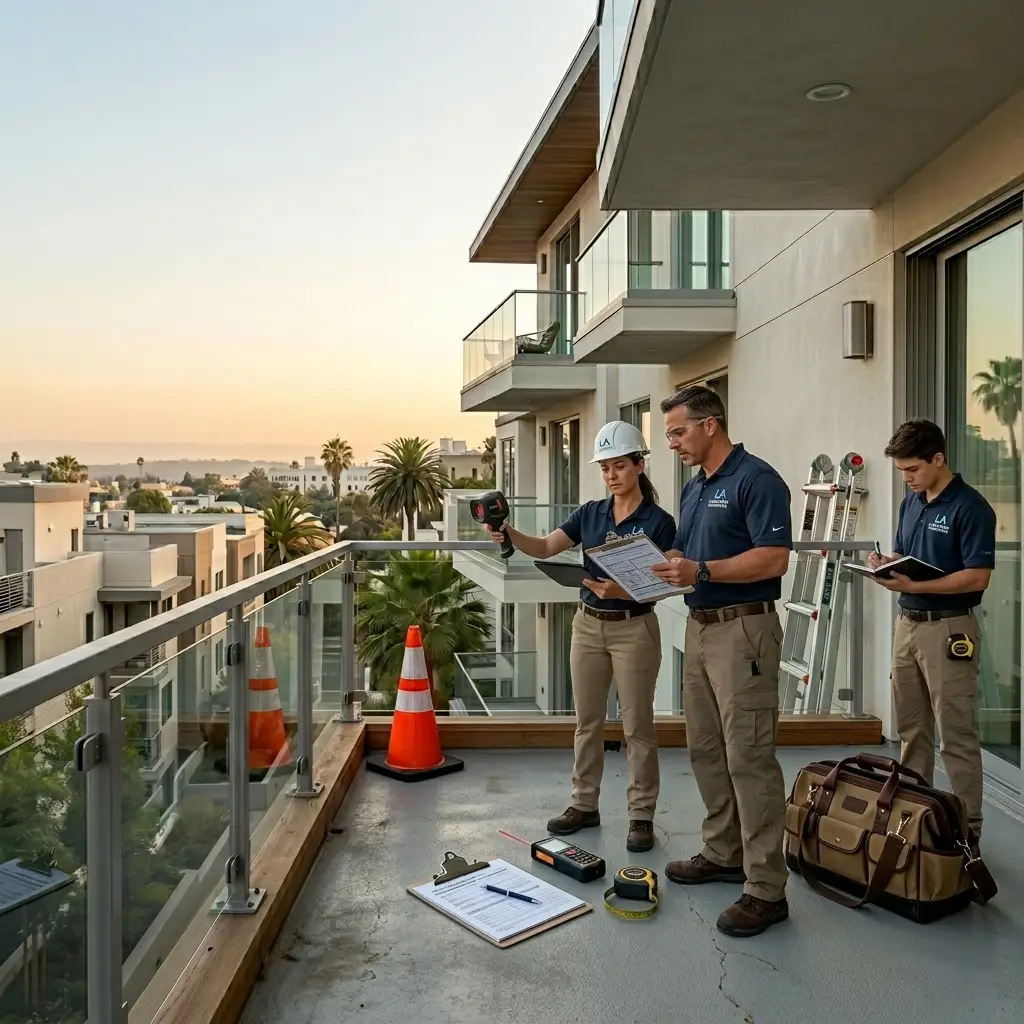
About us
Why Los Angeles
Trusts Our Team.
Local Expertise
Deep understanding of Los Angeles building codes and LAHD reporting requirements.
Fast Turnaround
We deliver comprehensive, signed reports within 45 days of inspection completion.
Transparent Pricing
No hidden fees. We provide clear, upfront quotes based on your specific property needs.
376+ Projects
Licensed & ISO Certified
Experienced Team
Authorized Inspectors
Inspector eligibility depends on the governing statute.
| Inspector Category | SB 721 (Apartments) | SB 326 (HOAs) |
|---|---|---|
| Licensed Architects | ✓ | ✓ |
| Licensed Civil Engineers | ✓ | ✓ |
| Licensed Structural Engineers | ✓ | ✓ |
| Qualifying Contractors (A, B, C-5) | ✓ | — |
| Certified Building Inspectors | ✓ | — |
*SB 326 inspector qualifications are stricter, limited primarily to licensed design professionals. AB 2114 added civil engineers to the HOA pool.
Reporting & Repair Obligations
Statutory requirements for documentation and corrective actions.
📄
Written Reports
SB 721 requires a written report within 45 days of inspection. SB 326 reports must be retained for two inspection cycles.
⚠️
Urgent Escalation
Immediate safety threats require urgent-condition notice to the owner and enforcement agency. Emergency conditions demand immediate action.
🔨
Repair Deadlines
For SB 721, permit applications for non-emergency repairs must be submitted within 120 days of identifying defects.
Not sure whether the building falls under SB 721 or SB 326?
Los Angeles properties often need a law-and-scope review before inspection scheduling. Building type, ownership structure, balcony configuration, and exterior elevated element count all affect the compliance path, report requirements, and repeat cycle.
Get Free Consultation