
376 Inspections Done
Destructive Testing for Balconies, Decks, and Exterior Elevated Elements
What is destructive or intrusive testing for Exterior Elevated Elements (EEEs)?
Destructive or intrusive testing verifies concealed EEE conditions when visual inspection does not resolve hidden damage risk. Inspectors open or penetrate finish materials. Inspectors confirm framing, waterproofing, and load-bearing components.
California EEE inspection practice separates visual review from invasive confirmation for owners who review California EEE safety and compliance requirements to satisfy state mandates.
What qualifies as an Exterior Elevated Element under this inspection topic?
Exterior Elevated Elements are balconies, decks, stairways, walkways, and landings that project from or attach to a structure. These components carry loads. These components also face weather exposure and concealed moisture risk.
EEE assemblies include joists, beams, posts, ledger connections, flashing, cladding, soffits, and waterproofing membranes. Failures in those components create safety risk. Failures also increase repair liability.
Sellers and buyers identify structures constituting exterior elevated elements over six feet high to determine where invasive probing is legally necessary.
What is the difference between intrusive testing and destructive testing?
Intrusive testing uses limited openings, while destructive testing removes materials far enough to expose concealed components directly. Intrusive testing creates less disturbance. Destructive testing gives higher-certainty diagnosis.
Intrusive methods include borescopes, probing, and limited access holes. Destructive methods include soffit cuts, stucco removal, siding removal, and selective demolition. The difference matters because scope, cost, and restoration needs change.
What do SB 326 and SB 721 control in destructive or intrusive testing?
SB 326 and SB 721 define the California inspection context, while destructive or intrusive testing serves as a condition-driven diagnostic step. These laws set property applicability. These laws also set inspection cycles and compliance expectations.
Multifamily property owners utilize exploratory openings to comply with SB 721 apartment inspection mandates by the 2026 deadline.
HOA boards authorize targeted demolition to verify SB 326 HOA inspection rules when visual red flags indicate concealed structural decay.
What does “least intrusive methods” mean in the inspection sequence?
Least-intrusive methods means inspectors start with visual review and lower-disturbance diagnostics before larger openings occur. This sequence reduces unnecessary finish removal. This sequence also improves opening accuracy.
Visual inspection, moisture screening, infrared review, and borescope access come first. Larger openings follow only when concealed framing or waterproofing remains unverified. That order lowers avoidable disruption.
What conditions trigger destructive or intrusive testing?
Water intrusion, dry rot, elevated moisture, inaccessible joints, and waterproofing failure trigger destructive or intrusive testing. Those conditions block reliable visual confirmation. Those conditions also raise hidden structural risk.
Inspectors escalate when staining, cracking, movement, ponding, or leak history points to concealed damage. Escalation also occurs when load-bearing connections stay inaccessible. Diagnostic certainty drives the decision.
What methods occur before destructive openings?
Visual inspection, moisture meters, infrared review, probe testing, and borescope inspection occur before destructive openings. These methods narrow the suspect area. These methods also reduce unnecessary cutting.
Inspectors use screening tools to locate wet zones and concealed anomalies. Inspectors then choose the most relevant opening location. That process improves efficiency and limits finish removal.
What does visual inspection establish before invasive work?
Visual inspection establishes the first condition record before invasive work begins. Inspectors document staining, cracking, movement, ponding, and visible distress. That record guides later testing locations.
Visual review serves as the procedural baseline. It also supports scope decisions and later reporting. A clear baseline improves diagnosis.
What does a moisture meter measure in EEE screening?
Moisture meters identify elevated wetness in wood or porous materials during EEE screening. Inspectors compare suspect areas against drier control areas. That comparison helps select the best opening location.
Moisture readings do not replace direct verification. Moisture readings guide targeted testing. Higher readings increase concern about concealed deterioration.
What does infrared review add to the workflow?
Infrared review adds anomaly detection by locating thermal patterns associated with wet zones or material separation. Infrared review helps refine opening locations. Infrared review does not prove structural decay by itself.
Thermal anomalies support screening decisions. Direct exposure still confirms the actual concealed condition. Infrared review improves targeting.
What does probe testing confirm?
Probe testing confirms localized softness, reduced resistance, or hidden deterioration in suspect materials. Probe testing adds evidence beyond visual suspicion. Probe testing helps justify targeted openings.
Inspectors use probing where materials appear intact at the surface. Loss of resistance signals possible concealed damage. That signal improves opening precision.
What does a borescope show before larger openings begin?
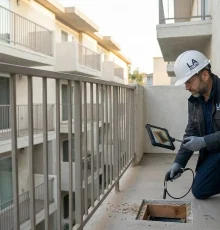
Borescope inspection shows concealed cavities through a limited access point before larger openings begin. Borescopes reduce disturbance. Borescopes evaluate concealed framing via borescope testing through small access points to bridge surface screening and direct structural exposure.
Borescope access works best when a cavity is partly visible through a drilled or cut hole. Borescopes help inspect hidden areas. Larger openings still follow when certainty remains incomplete.
What methods count as destructive testing?
Exploratory openings, soffit cuts, stucco removal, siding removal, and selective demolition count as destructive testing. These methods physically expose concealed framing. These methods also expose waterproofing interfaces and hidden joints.
Destructive testing creates direct access to concealed conditions. Direct exposure supports higher-certainty diagnosis. Direct exposure also informs repair scope.
What building components must destructive or intrusive testing actually examine?
Destructive or intrusive testing examines concealed components that carry loads or control water entry. Key components include joists, beams, posts, ledger connections, flashing transitions, and waterproofing membranes.
Inspectors also examine soffit cavities, cladding interfaces, and moisture-prone framing near leak paths. These locations often reveal concealed deterioration. These locations also shape repair decisions.
Direct exposure of joists and ledger connections allows engineers to evaluate structural safety through load-bearing path analysis.
What determines where inspectors make destructive openings?
Elevated moisture, visible distress, leak history, assembly geometry, and critical joint location determine opening locations. Openings target the most decision-relevant area. Openings do not target random finish surfaces.
Inspectors focus on high-risk joints and likely leak paths. Inspectors also consider underside, top-side, and interior access options. Access strategy affects restoration scope.
Does destructive testing happen on every balcony?
Destructive testing does not happen on every balcony by default. California EEE practice often uses representative or statistically significant sampling. Broader testing follows when early findings justify expansion.
Sampling reduces unnecessary disruption when conditions appear consistent. Expanded openings follow when visible red flags or early results indicate broader risk. Scope grows with evidence.
What does statistically significant sampling mean in this topic?
Statistically significant sampling means inspectors choose representative EEEs or high-risk locations to support broader condition inference. Sampling starts with a targeted set. Sampling expands when findings indicate wider risk.
Inspectors increase the sample when moisture, decay, exposure severity, or early openings reveal broader concerns. The goal is reliable inference. The goal is not arbitrary cutting.
What happens when destructive testing finds water intrusion or dry rot?
Destructive testing converts suspected hidden damage into documented repair scope when it confirms water intrusion or dry rot. Confirmed findings define the repair path. Confirmed findings also increase urgency when safety risk appears.
Findings often drive structural repair, waterproofing restoration, finish replacement, and stabilization. Direct confirmation replaces guesswork. Direct confirmation supports budgeting and compliance.
Confirmed findings allow licensed professionals to identify structural decay through dry rot detection in wood members behind finished surfaces.
What happens when destructive testing finds no major damage?
A negative opening still verifies concealed conditions at the tested location and supports the sampling record. The opening still has value. The opening also requires proper patching and waterproofing restoration.
Negative findings document what inspectors verified. Negative findings also close uncertainty at the tested area. Restoration remains necessary after the opening.
Who pays for patching, repairs, and post-testing restoration?
Payment responsibility for patching, repairs, and restoration depends on ownership allocation, contract scope, and repair phase responsibility. Common-area obligations often differ from exclusive-use obligations. Contract language also matters.
Inspection contracts, repair contracts, and governing documents shape the final allocation. Different trades may handle different phases. Clear scope reduces disputes.
Property managers request a licensed structural safety inspection quote to define restoration costs before authorizing invasive field work.
Who is liable if the patch later leaks or fails?
Patch failure liability follows the restoration scope, responsible trade, workmanship quality, and code compliance. A destructive opening creates a new water-management obligation. That obligation stays tied to the restoration work.
Liability analysis also depends on the handoff between inspection and repair services. Documentation matters. Proper detailing and execution matter too.
What lower-damage sequencing strategies reduce destructive openings?
Moisture mapping, borescope-first sequencing, top-side access, and targeted high-risk openings reduce destructive work. These strategies narrow the probable damage zone. These strategies also lower unnecessary finish disruption.
Inspectors use lower-damage methods to improve opening accuracy. Accurate targeting reduces cost. Accurate targeting also limits restoration scope.
What do HOA boards compare when firms propose different destructive testing scopes?
HOA boards compare legal rationale, sequencing logic, sample selection, opening locations, and restoration scope when firms propose different testing scopes. Boards also compare service independence. Boards also compare explanation quality.
A strong proposal explains why lower-damage methods do or do not answer the structural question. A strong proposal also defines documentation, repair handoff, and patching responsibility.
Comparison Table: What is the difference between visual, intrusive, and destructive testing?
| Method | Access level | What it evaluates | What it confirms | Typical tools or actions |
|---|---|---|---|---|
| Visual inspection | Lowest | Surface clues, drainage, visible cracking, and distress | Surface condition only | Walk-through review, photos, visible condition notes |
| Intrusive testing | Intermediate | Concealed cavities and suspect moisture zones | Hidden condition with limited opening | Borescope, probe testing, moisture meter, limited access hole |
| Destructive testing | Highest | Concealed framing, joints, and waterproofing interfaces | Direct condition of hidden structural members | Exploratory opening, soffit cut, stucco removal, siding removal |
What do property managers do before destructive testing starts?

About us
Why Los Angeles Trusts Our Team.
Local Expertise
Deep understanding of Los Angeles building codes and LAHD reporting requirements.
Fast Turnaround
We deliver comprehensive, signed reports within 45 days of inspection completion.
Transparent Pricing
No hidden fees. We provide clear, upfront quotes based on your specific property needs.
376+ Projects
Licensed & ISO Certified
Experienced Team
Authorized Inspectors
Inspector eligibility depends on the governing statute.
| Inspector Category | SB 721 (Apartments) | SB 326 (HOAs) |
|---|---|---|
| Licensed Architects | ✓ | ✓ |
| Licensed Civil Engineers | ✓ | ✓ |
| Licensed Structural Engineers | ✓ | ✓ |
| Qualifying Contractors (A, B, C-5) | ✓ | — |
| Certified Building Inspectors | ✓ | — |
*SB 326 inspector qualifications are stricter, limited primarily to licensed design professionals. AB 2114 added civil engineers to the HOA pool.