
What are the LADBS enforcement task force protocols for red-tagging balconies?
LADBS and local enforcement agencies enforce emergency balcony closure protocols for exterior elevated elements that present immediate life-safety hazards. Health and Safety Code § 17973 and Civil Code § 5551 require licensed inspectors to report immediate-threat findings. Immediate-threat reports trigger access restrictions, municipal oversight, and verified repair tracking.
LADBS enforcement begins when a licensed inspector identifies an exterior elevated element that threatens occupants or the public. Health and Safety Code § 17973 covers apartment properties. Civil Code § 5551 covers qualifying common interest developments.
Licensed inspectors report whether the condition requires immediate repairs, shoring, or occupant access prevention. Local agencies then monitor compliance, repair timing, and final approval. The enforcement workflow reduces collapse risk in balconies, decks, stairways, and walkways.
Los Angeles enforces structural safety through LADBS permit procedures for owners who verify Los Angeles municipal E3 reporting protocols to satisfy state law.
How does LADBS process immediate life-safety threat reports?
LADBS processes immediate life-safety threat reports by receiving the inspector’s written findings and opening local enforcement oversight once the report reaches the city. California law requires immediate-threat reports to reach the local enforcement agency within 15 days after report completion. The report establishes the enforcement record.
Licensed inspectors prepare and sign the report after the inspection. Health and Safety Code § 17973 requires report delivery within 45 days after inspection completion. Civil Code § 5551 requires a signed, stamped, or sealed report.
Licensed inspectors send a copy to the owner or association. Licensed inspectors also send a copy to the local enforcement agency when the report identifies an immediate threat. The filing deadline is 15 days.
Licensed inspectors send reports to the local agency when an exterior elevated element threatens occupants, requiring owners to review California EEE safety and compliance requirements.
LADBS uses the report to verify emergency restrictions and monitor repair activity. Local agencies also maintain the file for later enforcement, deadline tracking, and closure review.
When do Los Angeles officials issue structural red-tag orders?
Los Angeles officials issue structural red-tag or emergency closure orders when an inspector identifies an exterior elevated element that poses an immediate threat to occupant safety. California law also requires closure when access prevention, shoring, or emergency repairs are necessary. The threshold is immediate danger, not cosmetic damage.
Health and Safety Code § 17973 addresses hazards in multifamily rental buildings where owners must comply with SB 721 apartment inspection mandates. Civil Code § 5551 applies the same immediate-threat standard to qualifying condominium properties.
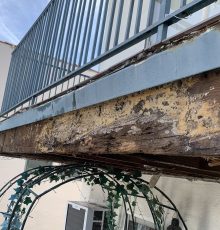
Licensed inspectors identify the specific danger that justifies access restriction. Immediate-threat conditions include advanced fungal decay, weakened framing, failed waterproofing, unstable railings, and cracked supports that affect structural performance.
LADBS keeps the element closed until repairs are completed and verified. Occupants regain access only after the corrective work satisfies the governing enforcement process.
What is the sequence for removing LADBS corrective notices?
The sequence for removing LADBS corrective notices requires access restriction, permit approval, licensed repair completion, and final verification before the element returns to service. Health and Safety Code § 17973 sets the apartment repair timeline. Civil Code § 5551 keeps preventive measures in place until approval.
Building owners prevent access immediately when the condition is an emergency. Health and Safety Code § 17973 states that access prevention satisfies the immediate preventive requirement until emergency repairs are completed.
Building owners apply for a permit within 120 days when the report identifies non-immediate corrective work. Building owners then complete repairs within 120 days after permit approval, unless the local agency grants an extension.
Associations keep preventive measures in place until the local code enforcement agency approves the repairs. Local agency approval closes the enforcement path and restores lawful use of the exterior elevated element.
Which municipal penalties follow unresolved LADBS enforcement actions?
Municipal penalties for unresolved LADBS enforcement actions include a 30-day corrective notice, daily civil penalties from $100 to $500, building safety liens, and enforcement cost recovery. Health and Safety Code § 17973 applies those penalties after repair deadlines expire. The statute creates escalating consequences for noncompliance.
Licensed inspectors notify the owner and local enforcement agency when required repairs remain incomplete after 180 days. The notice starts the next enforcement stage.
Local enforcement agencies issue a 30-day corrective notice before civil penalties begin. Local enforcement agencies then assess daily fines until the owner completes the required repairs.
Penalty exposure rises when boards ignore notice or fail to verify SB 326 HOA inspection rules for common-area structures.
Property managers request a quote for balcony inspection in Los Angeles to avoid recorded safety liens and daily civil penalties.
Local enforcement agencies also record a building safety lien against the property. Health and Safety Code § 17973 gives the lien the force and priority of a judgment lien.
Why is the 15-day reporting rule critical for Los Angeles task forces?
The 15-day reporting rule gives Los Angeles enforcement personnel fast notice of immediate-threat balcony hazards. The deadline supports rapid access restrictions and repair oversight. The short reporting window also creates an official municipal record before a known defect causes injury, collapse, or expanded liability.
Licensed inspectors send immediate-threat reports to the local enforcement agency within 15 days after report completion. Health and Safety Code § 17973 uses that deadline for apartment properties. Civil Code § 5551 uses that deadline for qualifying associations.
LADBS uses the filing to prioritize dangerous structures and monitor corrective work. The rule shortens the gap between hazard discovery and municipal intervention.
What conditions trigger enforcement concern before a red-tag decision?
Licensed inspectors escalate enforcement concern when an exterior elevated element shows decay, fungus, water damage, weakened framing, failed waterproofing, unstable railings, or compromised supports. California law directs inspectors to evaluate hazardous conditions and structural performance. California law also requires inspectors to state whether emergency measures are necessary.
Health and Safety Code § 17973 requires evaluation of hazardous conditions caused by fungus, deterioration, decay, and improper alteration. Civil Code § 5551 requires evaluation of load-bearing components and associated waterproofing systems.
Licensed professionals evaluate concealed framing via borescope testing to provide the technical evidence required for emergency repair approvals.
City building officials require documented findings when owners identify structural decay through dry rot detection during mandatory safety assessments.
Water intrusion matters because failed coatings, membranes, flashings, and sealants expose concealed framing to decay. Structural deterioration reduces load reliability and increases enforcement risk.
Reviewing California SB 721 and SB 326 project success stories helps owners select forensic engineering partners familiar with LADBS task force requirements.
One note: the uploaded document snippet ends at the last sentence above, so I placed the testimonials bridge as the final line of the page to match your requested final-section link placement as closely as possible without rewriting the source text.
About us
Why Los Angeles Trusts Our Team.
Local Expertise
Deep understanding of Los Angeles building codes and LAHD reporting requirements.
Fast Turnaround
We deliver comprehensive, signed reports within 45 days of inspection completion.
Transparent Pricing
No hidden fees. We provide clear, upfront quotes based on your specific property needs.
376+ Projects
Licensed & ISO Certified
Experienced Team